
Introduction
Remote-controlled (RC) airplanes are more than just display models—they are functional flying machines that bring the science of aviation into the hands of enthusiasts. From casual weekend pilots to dedicated hobbyists, RC airplanes offer a thrilling way to explore the principles of flight on a smaller, manageable scale. They rely on a careful balance of physics, electronic systems, and pilot input to stay airborne, making it essential for both beginners and experienced flyers to understand how these aircraft work in order to ensure safe, successful, and enjoyable flights.
At Dynam, our mission is to make this world of RC aviation more accessible. By designing aircraft that balance stability, performance, and reliability, Dynam helps beginners take their first flights with confidence and gives experienced pilots the thrill of scale realism and advanced maneuverability.
A Brief History of RC Airplanes

Early Beginnings
The prototype of remote control technology can be traced back to the genius inventor Nikola Tesla. In 1898, he demonstrated the world's first wireless remote-controlled boat at Madison Square Garden, which he called the "teleautomaton." This device transmitted commands via radio waves to control the rudder and propeller, laying the foundation for modern remote control technology.
During World War II, radio control technology was used for target drones to train anti-aircraft gunners. After the war, thanks to the widespread use of vacuum tubes and later transistor technology, civilian remote-controlled models began to develop. Early devices were very bulky, single-channel, and had very low control precision.
The Proportional Control Revolution
The most critical technological breakthrough was the emergence of proportional control systems. Unlike simple "on/off" commands, these systems allowed small movements of the control stick to correspond precisely to the deflection angle of control surfaces, enabling model airplanes to fly as smoothly as real aircraft.
The 2.4GHz Era and Modern Development
The development of microprocessors and integrated circuits made remote control devices smaller and smarter. Entering the 21st century, 2.4GHz spread spectrum technology completely replaced the old 72MHz frequency, solving signal interference and channel conflict issues. Frequency-hopping (FHSS) and direct-sequence (DSSS) techniques further enhanced anti-interference capabilities.
Lithium polymer (Li-Po) batteries and brushless motors provide powerful propulsion; flight stabilization systems composed of gyroscopes and accelerometers have become standard; FPV (first-person view) and autonomous flight technologies have brought remote-controlled flight into a new era of immersive and intelligent experiences.
Today, brands like Dynam have embraced these innovations, developing electric RC airplanes that blend modern technology with user-friendly design. By combining electric power, reliable radio systems, and stable airframes, Dynam makes advanced features accessible to both seasoned pilots and beginners—delivering great flight experiences straight out of the box.

The Science Behind Flight
Every RC airplane, regardless of size or design, obeys the same four forces of flight as full-scale aircraft:

Lift – Generated by the wings as air flows over and under them.
Thrust – Produced by the propeller or turbine engine pushing the airplane forward.
Drag – The resistance of air opposing forward motion.
Weight – The downward pull of gravity.
Balanced correctly, these forces allow steady flight. In a climb, thrust and lift must overcome weight and drag; in a glide, lift must still counter most of the weight.
How Wings Generate Lift
RC airplane wings are designed with an airfoil shape—curved on top and flatter on the bottom. As the airplane moves forward, faster airflow above the wing and slower airflow below it create a pressure difference, lifting the airplane into the sky. The angle of attack—the angle at which the wing meets the oncoming air—also plays a crucial role in generating lift.
Thrust and Propellers
A propeller is essentially a rotating wing. As it spins, its blades generate thrust by pulling or pushing air backward, propelling the airplane forward. Electric motors or internal combustion engines provide the power to spin the propeller.
Stability and Control
An RC airplane must be stable along three axes to ensure safe and predictable flight:
Pitch (nose up/down): controlled by the elevator.

Roll (wing tilt left/right): controlled by the ailerons.

Yaw (nose left/right): controlled by the rudder.

Longitudinal stability largely depends on the airplane's center of gravity (CG) and tail size. A forward CG provides more stability but requires higher speeds to maneuver, while an aft CG feels more agile but can be unforgiving for beginners.
Design features that enhance stability:
Dihedral: Wings tilted slightly upward increase roll stability, making the airplane easier to control, especially for new pilots.
Washout: Twisting the wing tips toward a lower angle ensures the wing root stalls first, keeping the ailerons effective longer and improving overall control during slow flight or stall conditions.
Dynam's design ethos: prioritize stable, confidence-building handling without dulling the fun. Many Dynam trainers use generous wing area, appropriate dihedral, and carefully set CG ranges to keep the airplane honest at low speed and responsive at cruise.
Understanding the Core Electronics of an RC Airplane
Building an RC airplane from scratch becomes much simpler once you understand how its core electronic components work together. At the heart of every RC model is a power system—consisting of a LiPo battery, an electronic speed controller (ESC), a brushless motor, and a propeller—which generates the thrust needed for flight. The battery feeds power into the ESC, which acts like a valve, regulating how much current reaches the motor based on your throttle input. Many ESCs also include a built-in BEC (battery eliminator circuit) that supplies power to the receiver and servos.
The receiver is the “brains” of the airplane. It decodes signals from the transmitter and sends commands to the motor and servos. Each port on the receiver represents a “channel,” such as throttle, elevator, rudder, or ailerons. Servos—small, precise actuators—convert these electronic signals into physical motion, moving control surfaces like the elevator and rudder to steer the airplane. Before flight, the transmitter and receiver must be “bound,” establishing a secure communication link so they understand each other’s signals.
Once everything is connected and powered, transmitter inputs translate into immediate and proportional responses: servos move the control surfaces, and the motor changes speed. Even a simple 3-channel setup—with battery, ESC, motor, receiver, and a few servos—gives you full control of pitch, yaw, and throttle. Understanding these core components and how they work together is the first step toward building and flying your RC airplane confidently.
Essential Components of an RC Airplane
Think of an RC airplane as a team of parts working together. Remove any key member and the mission fails.

4.1 Airframe & Structure
Fuselage: The main body that holds the battery or fuel tank, receiver, wiring, and often the landing gear. It must be rigid enough to resist bending while remaining light.
Wings: Wings generate lift. Most trainers use a high-wing layout for natural stability. Wing area, airfoil, and aspect ratio affect stall speed, glide performance, and responsiveness.
Tail Assembly (Empennage):
Horizontal stabilizer + elevator control pitch (nose up/down).
Vertical fin + rudder control yaw (left/right) and assist stability.
Landing Gear: May be fixed wheels, retractable systems, or even skids for belly landings.
Dynam value: durable foam structures with smart reinforcements (spares, doublers) to resist hangar rash and keep weight down, so pilots spend more time flying and less time repairing.
4.2 Powertrain
Motor and Propeller: Provide thrust. Electric brushless motors dominate today due to efficiency and reliability. Propeller size and pitch must match the motor and battery to avoid overheating and to deliver the desired thrust and speed.
Dynam equips its aircraft with efficient power systems that balance performance with endurance, ensuring smooth flights and dependable operation.
Electric: lithium-polymer (LiPo) batteries are standard; capacity (mAh) and cell count (S count, e.g., 3S, 4S) determine voltage and flight time.
Fuel: nitro (glow) or gasoline engines offer long flights and classic sound but require tuning and maintenance.
Dynam value: factory-matched motor/prop/ESC combinations that balance takeoff punch, cruise efficiency, and thermal reliability, so new pilots don't have to guess.
4.3 Control System
Ailerons: roll control for turning and leveling the wings.
Elevator: pitch control for climbs and descents.
Rudder: yaw control, useful for coordinated turns, crosswind handling, and ground steering.
Flaps (if equipped): increase lift and drag for slower, more controlled landings.
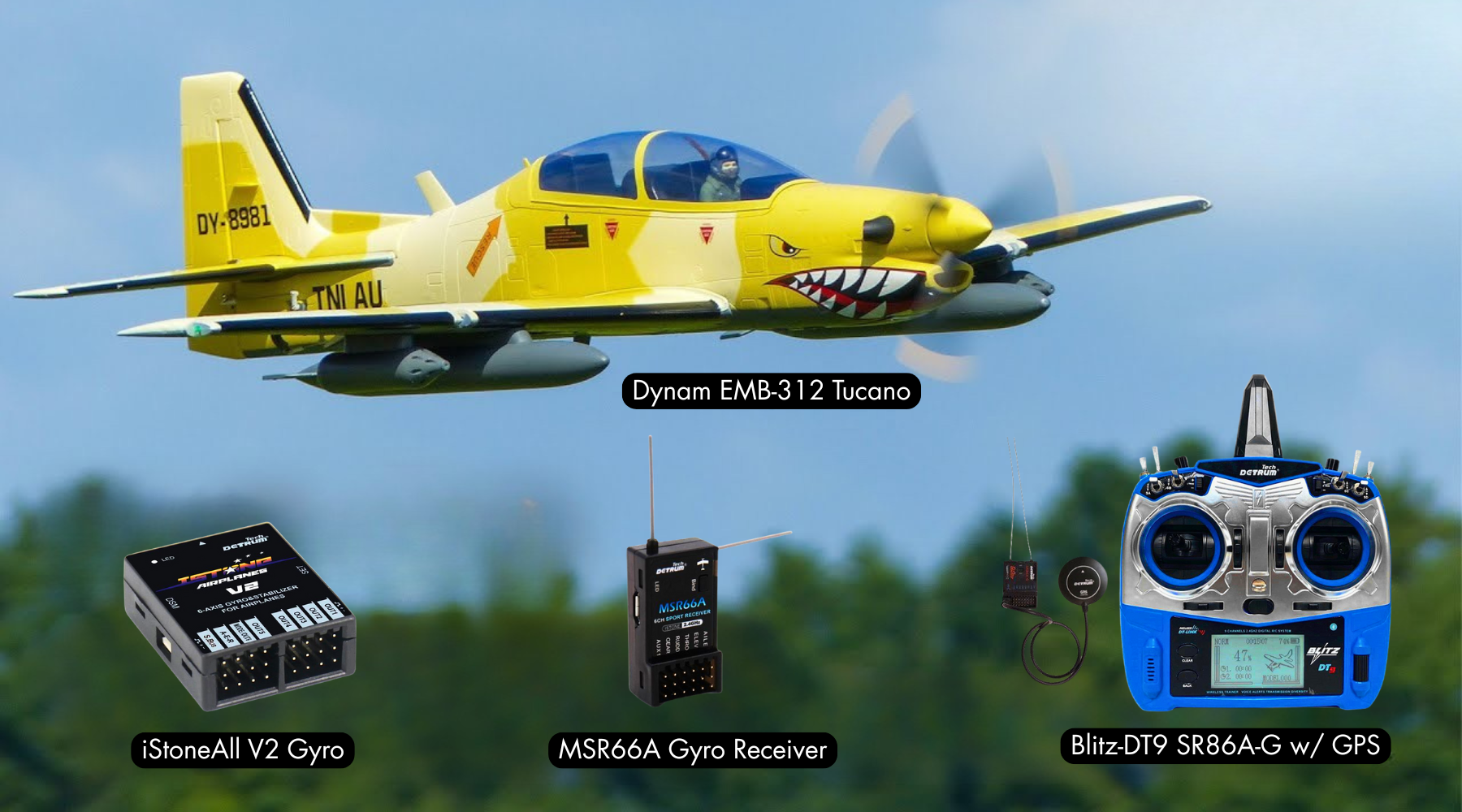
Receiver and Transmitter: Receives commands from your transmitter, decodes channels (throttle, aileron, elevator, rudder, and auxiliary), and passes signals to the ESC and servos. Antenna placement matters for reliable signal reception.
Servos: Small, precise actuators that move control surfaces. Quality servos with proper torque and centering help maintain accurate, repeatable control.
4.4 Flight Stabilization System
Usually integrated into the receiver or a standalone flight controller. Using built-in gyroscopes to detect abnormal aircraft attitudes (e.g., being pushed off course by wind), it automatically sends commands to the servos to compensate. This greatly enhances the aircraft's stability and controllability, which is especially important for beginners.
How RC Airplanes Operate
From Controller to Flight (Using a Dynam Transmitter as Example)

Flying begins with the pilot's input on the transmitter. With Dynam's GAVIN-8C 8-channel radio, every movement is instantly translated into precise control of the airplane. Under the common Mode 2 layout, the two main sticks handle the core flight surfaces, while additional switches and knobs operate flaps, retracts, lights, or flight modes.
Operation Flow with the GAVIN-8C:
1. Input – You move the sticks/switches on the GAVIN-8C.
2. Transmission – The radio sends reliable 2.4GHz spread-spectrum signals to the onboard receiver.
3. Decoding – The receiver interprets signals and passes them to servos and the ESC.
4. Servo & Motor Action – Ailerons, elevator, rudder, and throttle respond proportionally to stick movements.
5. Auxiliary Execution – Extra channels control flaps, retracts, or lights.
6. Failsafe Protection – In case of signal loss, the system reduces throttle and centers surfaces to avoid uncontrolled flight.
Mode 2 mapping (typical):
Left stick: Throttle (up/down), Rudder (left/right)
Right stick: Elevator (up/down), Ailerons (left/right)
The GAVIN-8C is designed for both beginners and advanced pilots:
Intuitive Layout – Standard Mode 2 makes learning easier.
Smooth, Proportional Control – Every stick input delivers accurate, real-time response.
Failsafe Safety – Built-in protection for peace of mind.
Expandable Features – Eight channels allow advanced setups, from retracts to LED lighting.
In short, modern RC flying is not just about aerodynamics—it depends on the reliability of your radio link. With Dynam GAVIN-8C, pilots gain precise control, secure connectivity, and the confidence to fully enjoy the experience of flight.
Types of RC Airplanes
RC airplanes span a wide spectrum of designs, each serving a different purpose—from steady learning platforms to high-performance aerobatic machines. Knowing the categories helps pilots choose a model that matches their skill level and flying goals.
Trainer Planes – High-wing trainers are the first stop for most pilots. Their stability and predictable handling make takeoffs, turns, and landings less intimidating.

Dynam focus: Our entry-level trainers are engineered with gentle stall behavior, stable ground handling, and straightforward assembly, giving first-time pilots the smoothest path into RC flight.
Scale Models – Scale aircraft replicate the look and feel of their full-sized counterparts. They are popular among pilots who love realism as much as flight performance.

Dynam focus: Dynam is well recognized for its warbird series, including the legendary P-51 Mustang, Spitfire, and Me-262. Each balances authentic scale presence with flight characteristics tuned for everyday enjoyment—so you don't just admire them, you actually fly them.
Gliders – Gliders are designed to stay airborne with minimal power, harnessing thermals and slopes. They reward patient pilots with long, graceful flights.

Dynam focus: lightweight structures and clean aerodynamics that make catching lift natural and rewarding.
3D Aerobatic Planes – These are designed for advanced pilots who want to push limits—hovering, torque rolls, and abrupt maneuvers require oversized control surfaces and strong power-to-weight.

Dynam focus: reinforced structures and precise servo response keep control crisp even under aggressive inputs.
Warbirds – Warbirds are a special category of scale models—faithful reproductions of WWII-era military aircraft. They combine history with performance and are a favorite step-up choice for pilots moving on from trainers.

Dynam focus: our warbirds are built for authentic detail and thrilling presence in the air, while still maintaining approachable handling.
RC Jets – Powered by electric ducted fans (EDF) or miniature turbines, jets deliver speed and sound that capture the essence of modern aviation.

Dynam focus: efficient EDF units, accessible designs, and practical operating requirements—so jet flying feels exciting, not overwhelming.
Each type serves a unique purpose, from learning to advanced aerial performance. Whether you are learning, practicing, or chasing realism, Dynam offers models across these categories, so every pilot can find a perfect match.
Applications Beyond Hobby
RC airplanes are versatile tools:
STEM & Education — tangible lessons in aerodynamics, electronics, and systems thinking.
Research & Prototyping — cost-effective flight testing and payload trials.
Professional Tasks — Used in aerial photography, surveying, agricultural spraying, power line inspection, disaster prevention and relief, and cargo delivery, becoming an important industrial tool.
Dynam value: approachable platforms with reliable electronics and serviceable airframes make them ideal for classrooms, clubs, and pilot programs.
Safety and Regulations
· Fly only in legal, open areas and maintain visual line of sight (VLOS).
· Respect altitude limits (often ≤ 120 m/400 ft).
· Stay clear of airports, restricted zones, and crowds.
· Perform a pre-flight check (linkages, surfaces, radio range, battery health).
· Treat LiPo batteries with care: correct chargers, no over-charge/over-discharge, safe storage.
· Check local rules; registration or competency requirements may apply.
As part of its philosophy, Dynam encourages safe and responsible flying. Many Dynam airplanes are designed with stable flight characteristics and durable structures to give beginners confidence, while also meeting the expectations of advanced pilots.
FAQ
Common Questions About RC Airplanes
How long can RC planes fly?
Typical electric trainers fly 10–15 minutes per battery. Efficient gliders can fly much longer, especially in rising air. Fuel engines often run beyond 15 minutes per tank, depending on throttle use.
Dynam tip: choose the factory-recommended prop and LiPo to balance thrust and endurance. Many Dynam trainers are optimized for meaningful practice time per flight.
Do I need a license?
Generally no for recreational models, but check local regulations for larger or commercial use. Requirements differ by country and sometimes by aircraft weight. Some regions require registration or operator IDs above certain thresholds, and most require you to fly within visual line of sight and below a defined altitude.
Dynam tip: join a local club—great for mentorship, safe fields, and staying current with regulations.
How fast can they fly?
Trainers: roughly jogging to cycling speed on approach, faster in cruise
Sport and warbird models: noticeably faster, often 60–100+ km/h
Specialized racing models: much faster still
Speed depends heavily on airframe, propeller pitch, and battery voltage.
Dynam note: our warbirds (e.g., P-51, Spitfire, Me-262) deliver scale-like performance while remaining flyable for pilots stepping up from trainers.
Which RC plane is best for beginners?
High-wing trainer airplanes with stable flight characteristics are recommended.
Dynam pick: Piper Super Cub—straightforward assembly, predictable stalls, and friendly ground manners make it a frequent first choice.
Do RC airplanes need fuel?
Electric RC planes use batteries, not fuel. Nitro and gasoline models use liquid fuel. Choose based on your preference for simplicity (electric) or endurance and sound (fuel).
Dynam focus: most Dynam aircraft are electric for low maintenance and consistent reliability, ideal for newcomers and frequent flyers.
RC airplanes are more than just models—they are miniature flying machines governed by real physics and powered by modern technology. From their early history to today's high-tech designs, they have grown into an educational tool, a recreational hobby, and even a research platform.
At Dynam, we are proud to be part of this journey. Our airplanes are crafted to inspire beginners, challenge experienced hobbyists, and bring the joy of flight to more people around the world. Whether you're taking off for the first time or adding another warbird to your collection, Dynam is here to help you soar higher.